
On 21 June 2024, our Zest for Work team held a webinar about “Happy, Healthy and Productive Employees” that went from the original science to the practical implications for organisations, including a concrete case study. Here is a summary of what we together with Professor Beatrice Van der Heijden PhD shared in the keynote “Sustainable Careers for everybody… ?!”. Prof. Van der Heijden PhD dedicated almost her whole scientific career to understanding careers and she shared her expertise on a scientific process model on sustainable careers driving a happy, healthy, and productive workforce.
A sustainable career brings together both the employee perspective and the organisation perspective to create sustainable performance, and a win-win for both the organisation and the employee. From the employee perspective, it is about staying happy and healthy in life and work, and the ability to contribute over the course of a lifespan through their work. From the organisation perspective, it is about keeping a sustainable performing and effective workforce that has the resilience and agility to respond to the rapidly changing requirements in today’s world of work.
Beyond describing the model and its various dimensions and indicators – which are described in our article “Building Sustainable Careers”– Prof. Van der Heijden PhD shared critical elements to understand how the concept of Sustainable Careers is shifting away from previous career models:
The definition of a sustainable career moves away from a standardized trajectory (e.g. vertical, horizontal). It is a unique sequence of career experiences that cross social spaces, patterns, different jobs, different departments, and organisations. In that sense, careers need to be viewed as unique personal trajectories that can’t be normalized (e.g. according to age, marital status, gender, initial education, etc.). It is like moving from ready-made clothes to tailor made ones that fit a specific person at this moment in time.
The scientific term here is “Idiosyncratic”; it is peculiar or unique to an individual. It requires to really look into the needs, challenges, strength, and weaknesses of a person throughout the lifespan in their particular constellation of life.
An example of an idiosyncratic career is the one of Yvon Golbach, Zest’s founder that moved across functional areas. She studied chemistry and went from chemical process engineering, to health and wellbeing, to entrepreneurship, and who know what comes next. Other unique sequences might include temporarily crossing social spaces from professional to personal care giver responsibilities. There are as many examples as possible unique individual trajectories.
A sustainable career takes an integrative perspective, a whole life approach. Work and private lives are integrated, all the different life spheres influence each other, and throughout your career, you will encounter disruptive events, both at work and at home that will trigger deliberate career reflection. This is what Prof. Jos Akkermans calls “Career shocks”, and in today’s volatile world of work, the occurrence of these disruptions is only increasing. They might reshape the career at any given moment in life and they can be both positive and negative.
Nobody can determine for you when your career is sustainable or not. The person is the actor of the career, who, in interaction with their stakeholders, shapes their career and make choices to create meaningful job experiences. And the stakeholders here are not only the direct supervisor and colleagues but also peers, friends, relatives and their institutional context.
Finally, she shared the latest science around aging at work. All companies have a set of HR practices, and current research focuses on determining which combinations are very fruitful across the lifespan. Yet, we need to look into a broader conceptualization of organisational age because “we know from research that calendar age doesn’t predict a large lot of variants in outcome measures such as job or career outcome measures”, noted Prof. Van der Heijden PhD.
Here are different views of age that can be looked at:
For those of you who like to go deeper in the underlying science, Prof. Van der Heijden PhD also shared three foundational theories that are used in studying sustainable careers:
(Hobfoll, 1989, 2001)
For people it’s worse to lose resources than the added value of gaining new resources. That’s why over time, with aging, people are inclined to be more focused on the prevention of loss and protecting what they have, while younger generations, who are more risk-oriented, are more focused on increasing their available resources. Over time, this change is also explained by lifespan theories.
(SOC, Baltes et al., 1999; SST, Carstensen, 1996; FTP, Lang & Carstensen, 2002)
Goal orientation changes over the lifespan. Growth becomes relatively less important, and with aging, maintenance and regulation of loss becomes more important. And that is also why, in general, older people are more inclined to focus on generally sharing their knowledge and protecting their strength at the current level.
(Deci & Vansteenkiste, 2004; Ryan & Deci, 2000)
The second domain self-determination theory described three basic psychological needs: the need for autonomy, competence or mastery and relatedness. These three needs are important to have an experience of a whole fulfilling life. The fulfillment of these needs changes with aging – e.g. relatedness becomes relatively more important.
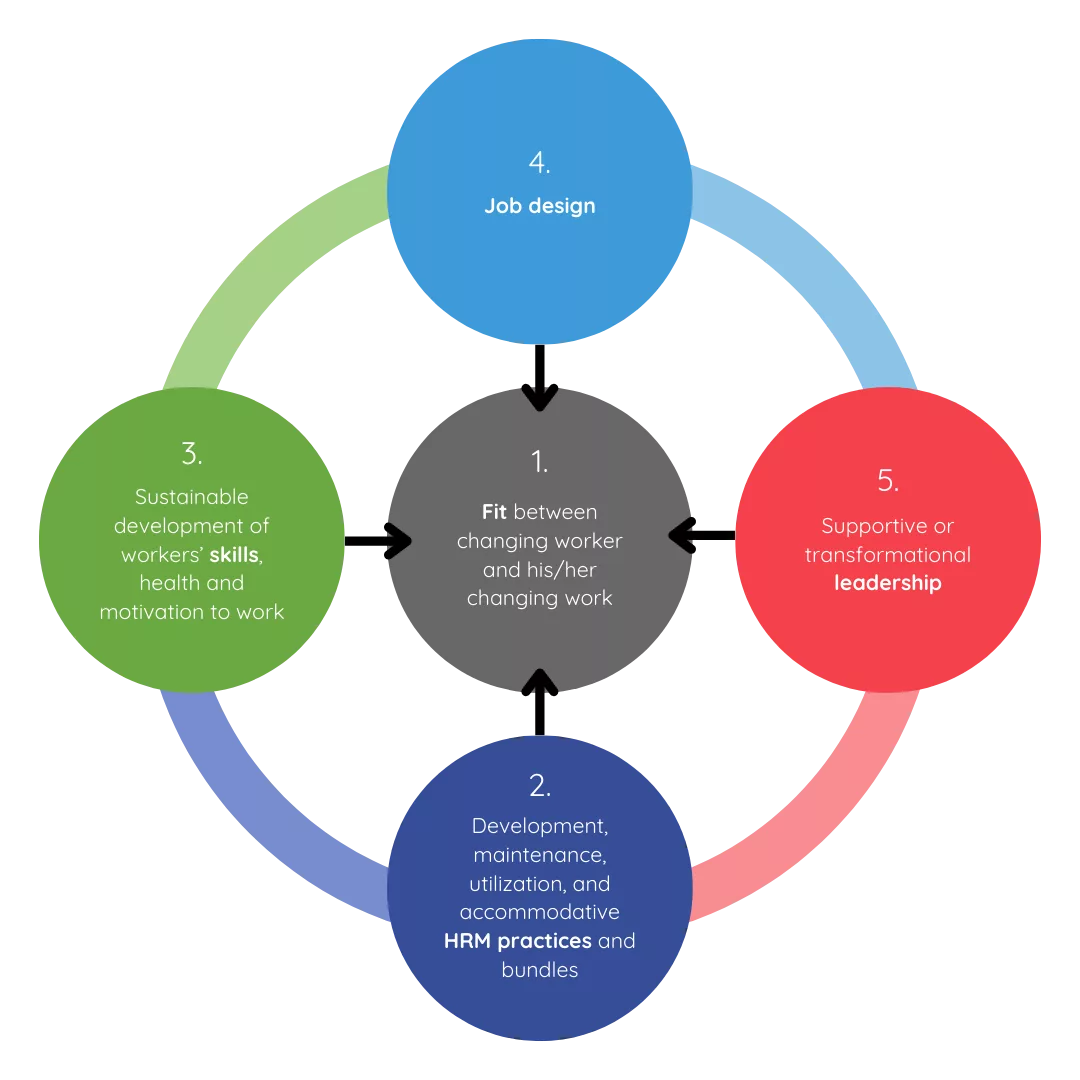
For organisations, one take away is to shift towards an integrated and flexible perspective on Careers. And like a puzzle, there are several pieces to it that complement each other to make a complete picture. Here are the puzzle pieces you can start to look into:
Visual adapted from De Lange, Van der Heijden, & Kooij, 2015
written by Caroline Thomas, Partner Zest for Work
“Sustainable Careers…?” keynote by Prof. Beatrice Van der Heijden PhD at Zest for Work’s “Happy, Healthy, and Productive Employees” webinar on 21 June 2024.